03-Particle_Physics

Summary

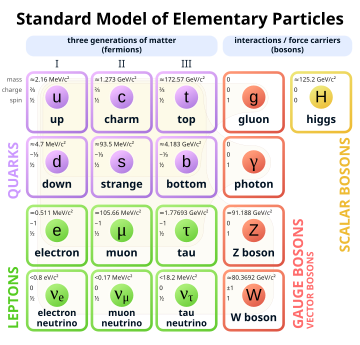
There are 17 fundamental particles. They are divided into groups. The first splitting is into the 12 fermions (obey Pauli Exclusion Principle) and the 5 bosons (force carriers, e.g. photons). Fermions are further split into leptons (no strong interactions, e.g. electrons) and baryons (e.g. protons and neutrons). There are also antimatter equivalents for all these particles (though sometimes the antimatter particle is the same as the regular one).

These particles are grouped according to the Standard Model.

Contents

  1. The Standard Model

  2. Fermions - Leptons

  3. Fermions - Baryons

  4. The Strong Force

  5. Bosons

  6. Feynman Diagrams

  7. Particle Accelerators

  8. Shortcomings of Standard Model

Fermions vs Bosons

  • fermions have half integer spin (\(\frac{1}{2}, \frac{3}{2}, \frac{5}{2}..\))
  • bosons have integer spin (0, 1, 2…)


  • fermions need to satisfy Pauli


  • fermions are the particles
  • bosons are force carriers

Fermions - the fundamental leptons

  • 6 of these
    • electron
    • muon
    • tau
    • electron neutrino
    • muon neutrino
    • tau neutrino

Muons (\(\mu\))

  • like heavy electrons (mass = 105.66MeV)

  • same charge, spin (like little magnet), lepton number (dictates what they can decay into, and what can decay into them)

  • unstable, lifetime of 2.2\(\mu s\), always produces an electron

  • produced in the upper atmosphere by cosmic rays (mostly protons) striking atmospheric molecules

    • the fact they can reach the ground before decaying is a beautiful demonstation of relativistic time dilation
    • about 1 muon per minute per \(cm^2\)

Tau (\(\tau\))

  • like an even heavier electron (mass = 1.78GeV)

  • again, same charge, spin, etc, as electrons and muons

  • unstable, lifetime of \(2.9 \times 10^{-13}s\)

  • many different routes of decay, including baryons

    • this is because \(\tau\) is so heavy
  • only detected in the laboratory, not seen in nature

Neutrinos (\(\nu\))

  • ghost like particle

    • no charge
    • not much mass (<1eV)
  • mostly produced by \(\beta\) decays

  • three different types, one for each of the leptons above

    • electron neutrino, \(\nu _{e}\)
    • muon neutrino, \(\nu _{\mu}\)
    • tau neutrino, \(\nu _{\tau}\)

  • vaste numbers produced in the Sun
    • 1 trillion solar \(\nu\)’s pass through you every second
    • you’ll only absorb one in your lifetime
  • really hard to detect
    • take an old gold mine in South Dakota
    • fill it with cleaning fluid
    • wait
    • about once a day get \(\nu _{e}+\ ^{37}Cl\longrightarrow \ ^{37}Ar^{+}+e^{-}\)

  • following on from Homestake, other neutrino observatories such as:
    • SuperKamiokande in Japan
    • Sudbury (SNO) in Ontario
    • IceCube at the South Pole (literally) - \(1km^3\)
  • in February 1987, sudden burst of \(\nu\)’s detected at various neutrino observatories
    • several hours later, light from a supernova in a nearby galaxy reached Earth
    • first time we’d seen this

Fermions - the baryons

  • protons and neutrons aren’t fundamental
    • they have internal structure
    • contain quarks
    • proton has 2 up and 1 down quarks
    • neutron has 1 up and 2 down quarks
    • up and down are two examples of the 6 quarks

Fermions - the fundamental baryons (Quarks)

Summary of Properties of Quarks
quark mass charge
up 2.16MeV +2/3
down 4.7MeV -1/3
strange 93.5MeV -1/3
charm 1.273GeV +2/3
bottom 4.183GeV -1/3
top 172.57GeV +2/3
  • note that \(m_{proton}\gg 2 \times m_{up} + m_{down}\)

Strong Force

  • quarks have colour and are subject to the strong force
    • colours are red, green, and blue
    • (and antired, antigreen, and antiblue)
    • particles always have to be colour neutral
      • red / green / blue
      • antired / antigreen / antiblue
      • red / antired, etc
    • force gets stronger with distance

Mesons

  • we observe quarks in triplets (e.g. proton), but also in pairs

    • these are called mesons
  • pions (~135MeV) are the lightest, made of up and/or down quarks

  • kaons (~500MeV) are similar, feature a strange quark

Particle Mass

  • things like particle charge, spin, etc have definite values

  • mass on the other hand seems more arbitrary

    • needs to be experimentally measured
    • see resonances in particle collider results
  • mass is an extrinsic (as opposed to intrinsic) quantity

  • acquired by particles as they move through the Higg’s Field

    • Higg’s Field slows them down
    • if a particle doesn’t move at the light speed, it must have rest mass
  • massless particles like photons (\(\gamma\)) or gluons don’t interact with the Higg’s Field, they must always move at the speed of light

The Four Three Forces of Nature

  • Gravity
    • really weak
    • always attractive (except on cosmological scales)
    • transmitted by gravitons
    • General Relativity
  • Electromagnetism
    • medium strength
    • +ve and -ve charges
    • mediated by photons, \(\gamma\)
    • Maxwell’s Equations, QED
  • Weak Force
    • pretty weak
    • explains \(\beta\) decay
    • mediated by W and Z bosons
  • Strong Force
    • only affects quarks
    • super strong
    • QCD, gluons e.g. \(g_{R\bar{G}}\)

Weak and electromagnetism united in to Electro-weak Force

Feynman Diagrams

  • neat way of picturing particle interactions

  • form basis for complex mathematical calculations

  • time flows from left to right

  • fermions represented by straight lines, bosons by wiggles, gluons by spirals

  • time flows backwards for anti-particles

  • at every vertex, quantities must be conserved

    • charge
    • colour (except for weak interaction)
    • lepton number
    • baryon number
  • two general types

    • scattering
    • annihilation

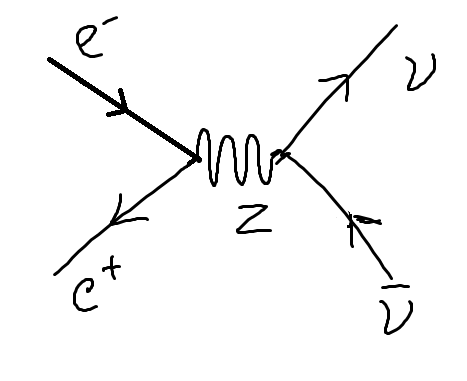
  • this is an annihilation process
  • central line
    • can’t be a \(\gamma\) as no charge on \(\nu\)
    • can’t be a gluon as no colour
    • can’t be a \(W^{\pm}\) as no change in charge
    • must be a Z

If you see a \(\nu\) or \(\bar{\nu}\) it must be a weak interaction

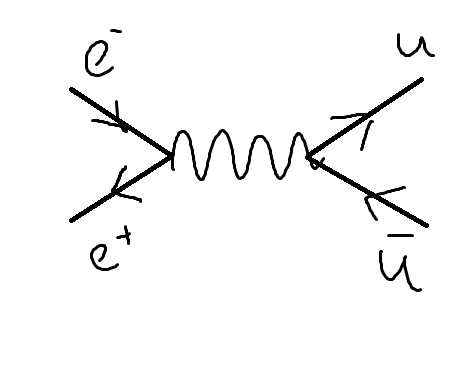
  • again, this is an annihilation process
  • central line
    • can’t be a gluon as no colour on \(e^{\pm}\)
    • can’t be a \(W^{\pm}\) as no change in charge
    • could be a Z or a \(\gamma\)

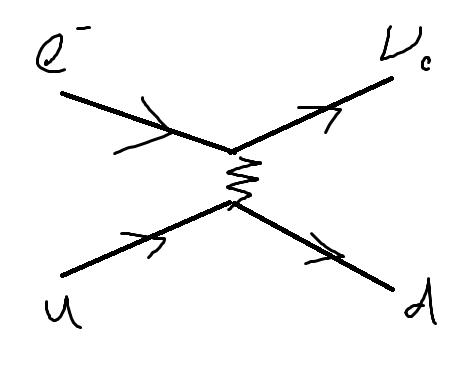
  • this is a scattering process as \(e^-\) can’t couple to u quark
  • central line
    • can’t be a gluon as no colour on \(e^{\pm}\) or \(\nu_e\)
    • can’t be a \(\gamma\) or Z as change in charge
    • must must be a \(W^-\)

Never have a vertex connecting a lepton to a quark

  • this is a scattering process
  • central line
    • can’t be a \(\gamma\), Z, or \(W^\pm\) as change in colour
    • must must be a gluon, \(g_{R\bar{B}}\)
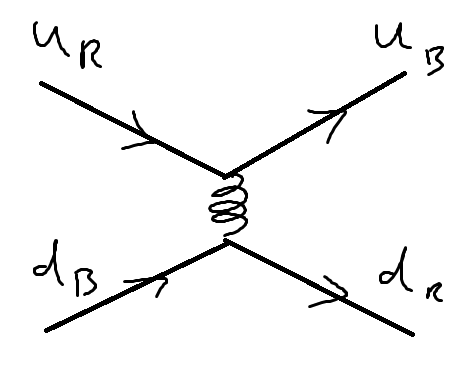
If all are particles (or all are anti-particles), then it must be scattering

Shortcomings of the Standard Model

  • very much a work in progress

  • doesn’t say much about particle masses

  • doesn’t have a strong candidate for Dark Matter

  • doesn’t have a strong candidate for Dark Energy

  • unknown why we live in a world of matter, not anti-matter

  • potential anomaly in magnetic moment of mesons

  • tough to reconcile with General Relativity

    • looking to detect Gravitons
  • neutrinos do something strange, seem to flip between \(\nu_e\), \(\nu_{\mu}\), and \(\nu_{\tau}\)

Particle Detectors

  • some of the biggest experiments

  • accelerators

    • linear
    • synchrotrons / cyclotrons
  • LHC at CERN

    • 14TeV
    • proton-proton collisions
  • Fermilab Tevatron

    • 1GeV
  • RHIC at Brookhaven
    • 250GeV
  • LIGO
    • looking or gravitational waves, gravitons
  • as well as peak energy, the intensity is important
    • looking for rare events

References